API stands for Application Programming Interface, which allows software systems to communicate with each other. API integration enables the automatic exchange of data between different software applications. It is one of the primary methods of business process automation that eliminates the need for human intervention.
The following points explain how API integration can drive automation, associated benefits and considerations.
Step 1: Elimination of Manual Data Entry
With API Integration, your employees no longer have to manually move data between systems (e.g. from a Customer Relationship Management system to an Accounting Software). Once data captured at the source, it will be automatically replicated across all the systems that are connected via API.
As a result of using this type of integration:
 You can reduce the amount of time that your employees spend on redundant manual data transfers.
You can minimize the number of errors that occur during the data transfer process (i.e. typos, missing information, duplicate entries).
Your company's costs related to "context switching" will be significantly reduced, since your employees will no longer be interrupted to perform administrative data entry while they are working on their primary tasks.
Step 2: Connecting Separate Systems
Companies usually have a bunch of different software for things like customer relations (CRM), managing stock, handling payments, sending emails, and HR. These often start out as separate systems. APIs help these systems share information in real time.
What this means in practice ? : When someone buys something on an online store, the inventory count can update right away, a shipping label can be created, and the customer can get a notification. No need to manually update things in different places.
Why it matters strategically ? : Getting rid of these separate data pockets means fewer guesswork moments when making decisions. For example, you'll know right away if a payment failed or if a return is coming in, instead of finding out much later, which can mess up cross depart-mental coordination.
Step 3: Acceleration of Business Workflows
Tasks that used to take many manual steps, like getting a purchase order approved by different departments, can now be done in seconds. This is possible when different systems are connected using APIs.
Here's how a workflow can be re-designed:
1. Someone requests a purchase.
2. An API checks if there's enough money in the finance system.
3. The right person gets one clear notification to approve it.
4. Once approved, the accounting system updates itself automatically.
This isn't just merely a faster version of manual process, but it's a whole new way of working, thanks to instant and real-time data access.
Step 4: Reduction of Operational Costs
The cost savings from using API integration are typically found in the following areas:
Decreased staffing requirements for repetitive coordination tasks
Reduced rework resulting from data entry errors
Lower dependency on institutional or "tribal" knowledge tied to specific employees
Simplified onboarding of new staff as they are able to perform work within automated systems rather than to learn and work around manual processes.
Step 5: Support for Real-Time Decision-Making
Late reporting is far worse than early reporting, as late reporting causes immediate decision defects (i.e. poor decisions are made immediately as a result of not having current information). API integration therefore supports real-time decision-making.
Applicable business functions:
Dynamic pricing adjustments
Inventory threshold monitoring
Fraud detection
Service-level agreement (SLA) compliance tracking
Step 6: Facilitation of Business Scalability
Manual processes generally scale in line with transaction volumes and headcount, but API-driven processes can scale very quickly with very low marginal cost per additional transaction processed through the API.
Implication for growth: Growth into new markets or of new vendors (e.g. regional payment service providers) can be supported by additional integrations instead of having to set up a completely new organization.
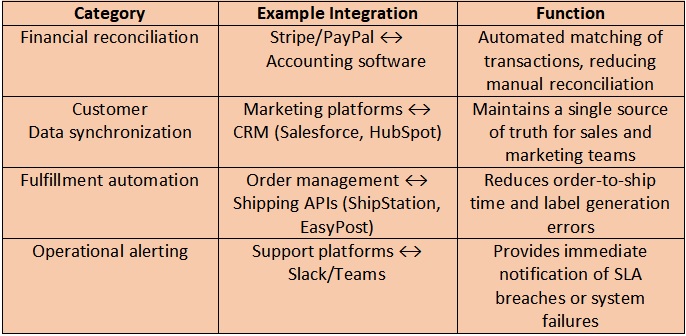
Step 7 : Representative use cases
Step 8: Factors for Continuous Care
API connections usually have to be checked on a regular basis as they are not a one-time project.
API version changes: Providers periodically deprecate or update endpoints
Rate limiting: High-volume times could exceed acceptable request limits.
Authentication expiration: Access tokens could expire, which would quietly stop processes from working.
Suggested strategies for reducing damage:
 Creation of an inside integration layer including error-handling and monitoring features
Adoption of Middleware systems like Zapier, Make, and Workato may help to centralize integration management without the need for specialized engineering staff for every connection.
Conclusion
API integration is the foundation for Business Process Automation. It helps to reduce manual work, to increase data quality, to accelerate processes and to scale up. However, in order to achieve these goals in the long term, the integration has to be maintained, monitored and governed.
Orisys Infotech, an API integration service provider in India can Integrate bespoke web application with any third party API providers such as Amadeus, Sabre, Travelport, TBO (Travel Boutique Online), Sun API, Aviate Group, Centrium, Company house API, GST API, Google APIs, Facebook API’s, SMS gateways, Payment gateways, Travel APIs, Hotel booking APIs, Flight booking APIs, Car rental APIs, Bus APIs and more.
| Understanding API Integration - What It Is, How It Works, and Why It Matters? |