What Is a Travel Portal?
A travel portal is a web-based service through which customers can make searches and bookings of various travel services like flights, hotels, holiday packages, car rentals, transfers, tours and activities. The back office includes the processes of managing inventory, bookings, payments, suppliers, commissions and employees.
Most portals usually belong to one of the following models:
 B2C portals sell services to consumers. It is the traditional web booking site.
B2B portals enable sub-agencies, corporates or partner agencies to make bookings at special or net rates.
B2B2C or hybrid portals use both of the above.
It is crucial to determine the right type of portal in the beginning since it defines many aspects including functionality, supplier integration and budgeting.
Why Travel Agencies Are Building Their Own Portals?
The online travel agencies and aggregators rank high on search engines, take commissions, and own the relationship with customers. In response to this, many travel agencies are developing their own portals. This is because:
The customers need to make reservations round-the-clock and not just during working hours.
Manually calculating and communicating with Excel sheets is time-consuming and error-prone.
The use of a portal will enable a small team to process more reservations.
Having control over the website means having control over customer data.
It allows differentiation by way of specializing in a specific field like pilgrimage tours, adventure travels, business travel, or regional packages.
Key Features of a Travel Portal
The right feature set depends on your business model, but most successful portals share a common core.
Customer-facing features
Search and filters. Quick search on destinations, dates, cost, reviews, amenities and type of travel. Speed and accuracy of searches have high impact on conversion.
Multi-product reservationFlights, hotels, packages, tours, transport and insurance all in one reservation process, preferably offering combination of products.
Dynamic packaging. The capability to allow customers create their own package out of the elements and see the cost.
Online payments. Payment options, currency options and compliance with standards of card handling.
User accounts. Travelers saved, history of reservations, wish lists and access to electronic tickets and vouchers.
Reviews and descriptive content. Photos, descriptions, maps and traveler reviews help increase customer trust.
Mobile-first approach. Many customers initiate or complete their reservation on mobile devices.
Multilingual and multi-currency support for international customers.
Agency back-office features
Booking management. Manage, modify, cancel and reprint bookings with status monitoring and auto confirmations.
Inventory and rate management. Manage your contracted rates, inventories, blackout periods, and seasonal rates.
Markup and commission policies. Establish markups by product, supplier, customer type, or agent.
Integrations with suppliers and APIs. Integrations with GDSes, flight and hotel aggregators, bed banks and local suppliers.
CRM and customer database. Manage inquiries, preferences, and contact history.
Accounts receivable. Create invoices, handle refunds, agent wallets, reconciliations and sales dashboards.
Role-based security. Differing access rights for admins, salespersons, finance, and sub-agents.
Notifications. Auto-emails, text messages, and WhatsApp messages for confirmations and changes.
Advanced features worth considering
A customer or agent mobile application
Loyalty programs, coupons and promo codes
AI-assisted recommendations and itinerary suggestions
Chatbots for common questions
SEO tools, landing page builders and email marketing integration
Corporate travel tools such as approval workflows, travel policies and expense reports
A sensible approach would be to launch with the basics and add the advanced features later when the portal is up and running and generating bookings.
The Travel Portal Development Process
Generally, the workflow of the project consists of these phases:
1. Discovery and planning. Figure out your target audience, your products, business model, and competitors. Determine what suppliers and payment gateways do you need.
2. Requirements and architecture. Document the list of features, user roles, integrations, and technologies.
3. UI/UX design. Design the search flows, booking funnels, and admin panel, paying particular attention to mobile version.
4. Development. Develop the frontend, backend, admin panel and supplier integrations
5. Testing. Test the booking processes, payment systems, performance, and security and address various cases, including cancellations and price changes.
6. Launch. Launch the platform to the public, typically with a limited selection of products.
7.Maintenance and upgradation. Monitor the performance, address emerging issues, and update the platform, including new systems and integrations.
Typically, supplier API integration takes the longest and is the riskiest stage since every provider has unique requirements and peculiarities.
Build Custom or Use a Ready-Made Solution?
Usually, agencies have three main options to build a booking system.
White-labeled or ready-to-use software. Usually, this is the fastest and the cheapest way to enter the market, but you have to consider that agencies have fewer customization options and typically pay higher fees.
Customized platform. In many ways, it is similar to the previous solution, but agencies get more control and customization ability within the existing framework.
Fully Custom Development. While it takes the longest time and requires the highest effort and budget, it also provides the best results.
If the business needs something standard, a customized ready-made solution might be the best choice. It will allow to enter the market faster and achieve a good balance between customization and costs. At the same time, if an agency develops a unique approach and wants full control over the booking system, a custom booking website is the best choice
Travel Portal Development Cost
The costs are highly variable, and as such should not be seen as any kind of firm quote, but rather as an estimate. The cost estimates given below are just estimates and are highly dependent on the location of the software development team.
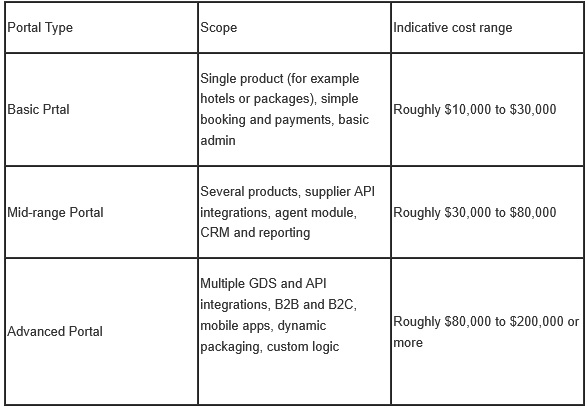
What drives the cost
 Number and complexity of Integrations. Integration with flight and hotel APIs usually involves additional setup, certification and use fees.
Variety of products. Flights are usually more complicated compared to hotels and tours.
B2B components. The agent structure, payment system and commissions increase the project scope.
Design and usability. Custom design is more expensive than using templates.
Mobile applications. Development of iOS and Android versions require extra development process.
Payment security. Payment security and data protection standards influence the development work.
Location and type of the team. There is a great difference between prices in different regions and from agencies and freelancers.
Ongoing costs to budget for
Launching a Travel Agency Website is not all; there are costs that will keep piling up. These include Hosting Fees, API and GDS Costs, Payment Gateway Cost, Security Upgrades, Support, Bug Fixes and Marketing.
Benefits of a Travel Portal for Agencies
1. A 24/7 Sales Channel
This gives clients the ability to book anytime regardless of their location, day or time.
2. Low Operational Efforts Per Booking
With automation of quote generation, confirmation, billing and reconciliation process, agencies can increase the number of bookings made by the same staffs.
3. High Margins and Pricing Power
You determine your own markup, offers and packages and have little dependency on external platforms which take commissions.
4. Control Over Your Customer Data
Customer data on booking trends and preferences enables you to make campaigns, sell add-ons and ensure they return to travel again.
5. Extended Reach
The website will have customers outside the local geographic location and B2B modules for sub agents who sell your product portfolio.
6. Branding and Credibility
A well designed and secured booking system will enable you to be seen as alternative platform to bigger players.
7. Insight Through Data
Dashboard provides analytics about destinations, products and campaigns which have better conversion rates and help in setting prices and inventory.
Common Challenges and How to Avoid Them
Underestimation of integration efforts. Begin with a few good suppliers and scale up later.
Excessive development at go-live. Launch with one version only and evolve through customer usage.
Lack of SEO and marketing. The portal will not pull customers on its own. Plan for content, SEO, PPC and email marketing.
Poor mobile usability. Check all booking steps on real mobile devices.
Insufficient payment and security setup. Utilize reputable gateways and security checks regularly.
No support strategy. Customers need fast help for changes and cancellations when traveling.
How to Choose a Travel Portal Development Partner
When evaluating a development company, look for:
Proven experience in developing booking systems and working with suppliers' APIs
Examples of successfully delivered solutions (live portals), case studies for reference
Clear process for project scoping, testing and post-launch support procedures
Transparent breakdown of costs with nothing hidden
Disclosure about code and data ownership
Security expertise and knowledge of payment industry standards
Flexibility to deliver the product in phases to get you up and running faster
Request a detailed project scoping and timeline before finalizing agreements, and clarify who shoulders the costs of third-party API payments.
Conclusion
Creating travel portal website is the most efficient approach for any travel agency to upgrade, grow and secure margins. The main factor that leads to the greatest success is a proper business model, an appropriate first version, integration with reliable suppliers and persistent marketing activities. Begin with products and clients that you understand well and then gradually expand your portal based on booking volume.