Custom software development refers to the whole process of designing, building, testing, and later maintaining software that is created specifically for one organization, team, or actual use case — not something you just buy as a ready-made product made for the mass market.
Off-the-shelf software (like Salesforce, QuickBooks, or Shopify) is built to serve thousands of different businesses in the same go. So to make that work, vendors create broad generalized features, and they expect you to adapt your workflows so they match their product. Custom software somewhat flips this, you know, the whole relationship : the software adapts to you.
Instead of purchasing a tool and then reshaping your business around its limitations, you commission (or build internally) a solution that mirrors your exact procedures, data formats, user roles, and goals — starting from day one.
It is different from :
 Off-the-shelf (COTS) software — pre-built, sold to lots of customers, limited customization
SaaS platforms — subscription-based, shared infrastructure, configurable but usually not fundamentally alterable
Low-code/no-code tools — faster and less costly, yet constrained by the platform’s building blocks
Custom software — built directly from the ground up (or heavily extended from a framework) around your specific requirements, with full control over features, architecture, and data
Key Characteristics of Custom Software:
1. Built for a specific organization or use case, not available widely - Every design choice derives from your company's actual needs, not a hypothetical average user.
2. Features that fit your processes - Customized features, not general ones Every screen, process, and automation reflects how your team really functions; no unused menus, no missing essential feature necessitating a workaround.
3. Ownership of source code - Most custom development agreements let you own the source code outright. You own the asset; you are not licensing access.
4. Architected for your scale and future - Designed for your size and future Unlike standard software with set levels, a bespoke system may be built from scratch to match your particular development path, data volume, and user load.
5. Deep integration capability - Custom software can be made with direct, native interfaces into your current databases, old systems, and third-party APIs instead of depending on fragile, constrained integration a provider decided to support.
Benefits of Custom Software Development
1. Ideal Fit for Business Need
Average consumers are the target of generic software; most businesses only utilize a fraction of its functions while always hitting roadblocks where it falls short of their requirements. Custom software solves this mismatch by doing exactly what your company needs, nothing more, nothing less.
2. Competitive Advantage
If your rivals can also purchase off-the-shelf software, it cannot help you to keep that advantage. Your operational process is part of what makes you better than them. Custom-built technologies enable you to encode your special process, pricing structure, or client experience into the software itself, so making it more difficult for others to duplicate.
3. Scalability Without hard limit
Software designed for business sometimes comes with strict restrictions: user caps, storage caps, API rate limits, or pricing levels that stifle development. Custom software is designed to match your development curve, hence scaling up doesn't entail moving to another platform or paying harsh update costs.
4. Better integration
Modern companies depend on a patchwork of tools including ERPs, CRMs, payment processors, internal databases, and IoT devices. Custom software may be designed to fit at the center of that ecosystem, pushing and pulling data easily instead of being constrained by whatever pre-built connectors a provider happens to provide.
5. Long-term Cost Effectiveness
Off-the-shelf software usually appears less expensive up front but includes ongoing per-seat or per-transaction costs that grow along with your company. Though it starts off more expensive, custom software usually ends up being the less expensive choice over a 5–10-year period, particularly at scale, as there is no continuing licensing tax.
6. Integrated Security and Compliance
Strictly regulated industries (healthcare/HIPAA, banking/PCI-DSS, EU data/GDPR) often discover that off-the-shelf software compromises compliance. Custom software allows you to create access controls, audit trails, encryption, and security architecture that precisely satisfy your regulatory requirements from the first line of code.
7. Total Authority and Control
You are not at the mercy of a supplier's pricing adjustments, feature discontinuations, acquisition, or shutdown. You control the plan. Want a new feature? You build it yourself instead of waiting for a supplier to give your request top priority among thousands of other clients.
8. Better user experience for your particular users
Rather than a general UX created for the largest possible audience, custom software may be designed around the real skill level, habits, and mental models of your particular staff members or consumers.
The Custom Software Development Process
Phase 1: Requirements Gathering & Analysis
The key to any successful custom software project is a strong requirement gathering & analysis phase at the beginning. This is where stakeholders are interviewed, current business processes are mapped out and key pain points are highlighted. In addition to this, it is crucial that technical constraints such as existing systems, current compliance requirements, budget and time are documented.
Many project failures are due to people not completing a thorough requirement gathering phase at the start of a project, resulting in expensive rework later down the line.
Typical deliverable in this phase are: Requirements document, user personas, process maps and technical feasibility assessment.
Phase 2: Planning & Design
In the design phase of Custom Software Development we create a plan for the development of software and define the technical architecture to deliver the planned solution. During this phase we create wireframes and mock-ups of the User Interface / User Experience for approval.
Typical outputs: architecture diagrams, wireframes/prototypes, sprint plan, cost estimate.
Phase 3: Development
All the coding work happens here. And today mostly in an Agile/Scrum process where you first divide your work into Sprints (about 1-4 weeks) and then do one complete functionality for one demo at the end of a Sprint in order to get as often as possible feedback for improvements of not only the produced work but also for planning of the rest of the project in the better way instead of finding all errors and bugs in the very end of the project and then doing fixes with much higher effort.
These deliverables are: Working software, i.e. parts of the system, completed in the course of the project, and presented at the end of a Sprint in a demo. Updated project backlog.
Phase 4: Testing & Quality Assurance
In parallel to the Development Phase, we Test. The testing of software is usually divided into four main types of testing:
Unit testing — individual components work correctly
Integration testing — components work together and with external systems.
Security testing — vulnerability scanning, penetration testing
User Acceptance Testing (UAT): the software is put through its paces by the real users of the software to determine whether the software does actually what they need it to do.
Phase 5: Deployment
This is where we send the software off to production for the users. Frequently this is a staged release, where first a pilot group of users is released to, and then once all the kinks are worked out, it is released to the entire user base to minimize the amount of time that there is potential for disruptions to business.
Phase 6: Maintenance & Support
Your Custom Software Never Ends. Bug fixes, software updates, and modifications can be introduced as necessary after release of the software.
We monitor the performance of your custom software in-house and include modifications for future updates. This is the life of custom software-never ending but perfect for your organization in the long run.
Custom Software vs. Off-the-Shelf: When Each Makes Sense
Choose off-the-shelf when:
Your process is fairly standard (basic accounting, generic project tracking, common HR workflows)
Speed to launch matters more than a perfect fit
Budget is limited and the software isn't core to your competitive advantage
Choose custom development when:
 Your workflows are genuinely unique and off-the-shelf tools create constant friction or workarounds
The software itself is your competitive advantage, or core to your product
You're outgrowing the scalability or integration limits of existing tools
Compliance or security requirements aren't well served by generic solutions
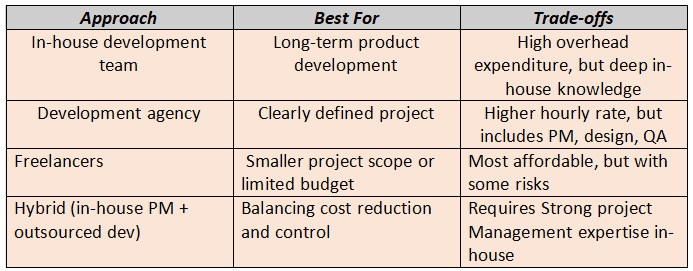
How to choose a development approach?
Conclusion:
The advantages of custom software development come at the price of greater expenses and more time spent on the development process because it will result in tailor-made software which can be scaled as required and serves as an asset instead of a cost. It is up to you to choose the best solution depending on the uniqueness of your processes and their importance for your competitive edge.